
Schneider Electric is buying PTC for $22.6 billion: what a digital thread is and what a small manufacturer can take from the idea
Topics: Industry, Automation
Short answer: on October 5, 2026, the French company Schneider Electric, a large player in energy and automation, announced that it is buying the American company PTC for cash, at $205 per share. The whole company is valued at about $22.6 billion for its shares, or $23.7 billion including debt. PTC makes software in which products are designed and data about them is kept over their entire life: from the drawing to servicing. Schneider explains the purchase with a "digital thread": a link between all the data about a product, from design to operation and repair. The deal is expected to close by the third quarter of 2027 if PTC's shareholders and regulators approve it. The independent analyst firm Interact Analysis finds the logic of the deal convincing but points to the high price and the complex integration, and Schneider's shares, according to The Robot Report, fell noticeably after the announcement. A small manufacturer does not need such a purchase to take the main idea: one product number and drawing version everywhere, service history by serial number, and starting with servicing. Below are the terms of the deal, the key terms explained without jargon, the analyst's view, three steps and a calculation.
Terms of the deal
According to the Schneider Electric and PTC press release of October 5, 2026:
- Price. $205 per share in cash for 100% of PTC's shares. That is about $22.6 billion (€20.1 billion) for the shares and $23.7 billion (€21.1 billion) including debt.
- Premium. The price is 42.3% above PTC's last closing price before the announcement and 46.1% above the average price over 30 trading days, weighted by trading volume.
- Timing. Closing is expected by the third quarter of 2027. It requires approval by a majority of PTC's shareholders and regulatory approvals. PTC's board of directors recommended that shareholders approve the deal.
- Money. About €22 billion is secured by a loan from the banks Morgan Stanley and Société Générale. Schneider plans to cover the total amount by issuing shares worth about €5-6 billion and new debt of about €16-17 billion.
- The company's expectations. By the third year, Schneider expects about €250 million in annual cost savings and about €800 million in additional revenue. This is the company's own forecast.
About PTC, the same press release says: more than 30,000 customers worldwide and revenue of €2.4 billion in 2025.
What PTC does and what a digital thread is
A few words you need to understand the news.
- CAD is software for designing products on a computer: drawings and 3D models of parts. At PTC, this is Creo and the cloud-based Onshape.
- PLM is keeping track of data about a product over its whole life: which drawing versions existed, what the product is made of, what changes were made. At PTC, this is Windchill.
- Codebeamer at PTC handles requirements, testing and traceability for products that contain more and more software.
- ServiceMax is software for field service, which, among other things, keeps the service history of equipment at customers' sites.
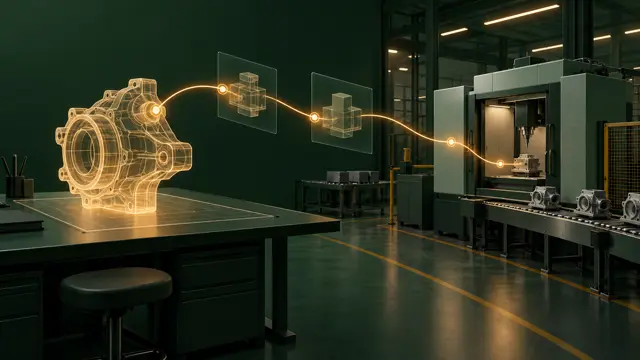
A digital thread, translated from press-release language, is the linking of this data into a single chain. Schneider, as reported by The Robot Report, promises continuity from the drawing to the shop floor, faster testing of robots in computer simulation, help with regulatory compliance and with maintenance. In a simple example: from the serial number of a machine at a customer's site, you can see which drawing version it was built to, which parts are in it and what has been repaired. Ideally, when it breaks down, service can then find out which part is needed, and the designer can see which design decisions break more often.
Schneider already owns AVEVA, which makes software for running plants, and has agreed to buy Cognite, which works on industrial data and AI; the Cognite deal has not yet closed. PTC adds product design to this.
What an independent analyst says
Interact Analysis, a research firm, analysed the deal on the day it was announced, and its analyst Matthieu Kulezak commented on it for The Robot Report.
- Why. PTC gives Schneider a shortcut from plant operations and energy into product design and strengthens it against Siemens, as well as against Dassault Systèmes and Autodesk in design software.
- The gap with Siemens remains. According to Interact Analysis, Siemens has a large advantage in advanced computer simulation, and buying PTC alone will not close it. For scale, the analyst cites revenue: about €17.8 billion for Siemens Digital Industries in fiscal 2025, compared with about €9 billion for Schneider's industrial automation and PTC combined. Both figures include hardware and services, not only software.
- Where benefits may come sooner. Kulezak suggests that the first measurable results may come from servicing, ServiceMax: if product configurations, service history and operating data are linked, it becomes easier to sell maintenance contracts, spare parts and equipment upgrades. This may pay off sooner than fully linking design and production.
- The main risk. According to Kulezak, Schneider will have to absorb thousands of employees while aligning product roadmaps, sales incentives and data architecture. Separately, it will have to manage the overlapping capabilities of AVEVA and Cognite without slowing development.
- Market reaction. According to The Robot Report, Schneider's shares fell noticeably after the announcement. Kulezak attributes this to the 42.3% premium, the large amount of borrowed money and the fact that the benefit depends on future results of the combination. At the same time, he finds the long-term logic of the deal convincing, and sees the question as whether Schneider can get enough value to justify the price.
What a small manufacturer can do on its own
These are my tips, not a conclusion from the press release. To get part of the benefit of a digital thread, you do not have to buy large systems: you can start by putting the data you already have in order.
- One product number and drawing version everywhere. Each product has one number in the design documents, in production and in service, and each drawing has a version number.
- Who does it: the chief engineer or process engineer.
- How to check: take 10 products sold in the past year and, using the serial number of each, find the drawing version it was built to. If you could not find it for some product, that is exactly where the chain is broken.
- Service history by serial number. Every repair and every part replacement is recorded against the product's serial number, not only against the customer.
- Who does it: the head of service.
- How to check: for 10 random serial numbers, you can open all the repairs done on them without asking colleagues or digging through paper logs.
- Start with servicing. If you sell and service equipment, the link "product and its repairs" may deliver benefits sooner than the link with design. This is also what the Interact Analysis analyst suggests for the deal itself.
- Who does it: the owner together with the head of service.
- How to check: before you start and after three months, compare how much time service spends preparing for a call-out and how many call-outs have to be repeated because of the wrong part.
How much this can save
An example with made-up numbers; substitute your own. Service makes 60 call-outs a month. Before each one, an engineer spends 20 minutes finding out what product the customer has, its configuration and what has already been done to it: 20 hours a month. If the history by serial number opens in 5 minutes, the search takes 5 hours, a saving of 15 hours a month. At an engineer's cost of 1,500 rubles an hour, that is 22,500 rubles a month. From this, you need to subtract the time to put numbers and history in order once, the time for keeping the service history up to date, and the cost of the software if you buy it. Repeat call-outs are worth calculating separately: each call-out that did not have to be repeated because of the wrong part also saves the travel.
If there are few call-outs, for example five a month, the saving on searching will be just over an hour a month, and putting numbers in order is worth doing for other purposes, for example warranty tracking, rather than for service time.
When this does not concern you
If you do not design products yourself but resell other companies' products, whether you need the link with drawing versions from the first step depends on your tasks, for example on whether you service what you sell. The news of the deal is then more a signal of where large industrial software suppliers are heading. Keeping track of serial numbers, configurations and customer requests may still be useful to you if you service what you sell or provide warranty.
Summary
On October 5, 2026, Schneider Electric announced the purchase of PTC at $205 per share, about $22.6 billion for the shares and $23.7 billion including debt, with closing expected by the third quarter of 2027. The company describes the point of the deal as a digital thread: a link between product data from the drawing to servicing. The independent analyst finds the logic convincing but sees a large integration risk and a gap with Siemens in simulation, and in his view servicing may deliver benefits soonest. A small manufacturer should take the simple part from this: one product number and drawing version everywhere, service history by serial number, and starting with servicing.
I work on AI agents and automation. If you would like to see my projects or discuss your own task, take a look at my portfolio.
Sources
- Schneider Electric, 05.10.2026: Schneider Electric to acquire PTC, creating the next level of Energy and Industrial Intelligence (press release, PDF). https://www.se.com/ww/en/assets/pdf/Schneider-Electric-to-acquire-PTC
- Interact Analysis, Matthieu Kulezak, 05.10.2026: Schneider Electric's PTC deal: a new challenger to Siemens. https://interactanalysis.com/insight/schneider-electrics-ptc-deal-a-new-challenger-to-siemens/
- The Robot Report, 07.10.2026: PTC acquisition positions Schneider Electric to challenge Siemens. https://www.therobotreport.com/ptc-acquisition-positions-schneider-electric-challenge-siemens/