
Industrial Next promises to retool production lines in minutes: what is claimed and four numbers to ask a seller for
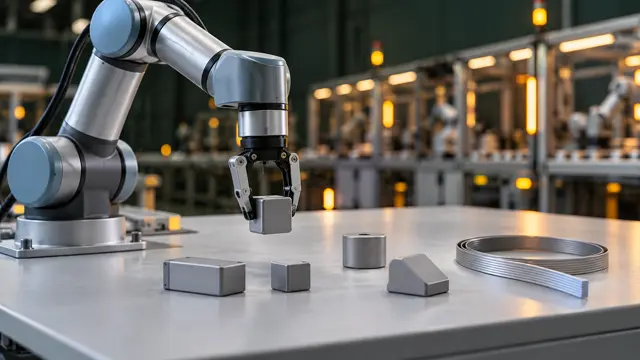
Short answer: the startup Industrial Next from San Francisco spoke on the TechCrunch Disrupt stage on 13 October 2026, and according to TechCrunch the company claims that its AI-powered robotic stations allow a line to be retooled in minutes rather than weeks, without the usual programming. The claims about speed, accuracy and use in the article are the company's own words, and there are no independent measurements. For a small factory the main question is how to test such a promise before buying. Below is what is claimed, how the company explains it, and four numbers worth asking the seller of any such system for.
What is claimed
There is one source: Aisha Malik's article in TechCrunch dated 13 October 2026. This is a retelling; I did not read the company's own page.
- What the problem is. According to the author, automation in most factories is rigid: robots and machines are programmed for one task and one product. To change a line, you have to reprogram it and physically retool it or replace equipment, and that, according to the text, can take weeks or months.
- What the company offers. Industrial Next builds self-contained robotic stations controlled by its own neural networks, that is, programs that learn from examples. According to the company, they connect what the station sees, a description of the task and motion. According to the founder, training takes place in a very precise computer model of the real world and by demonstration of the operation. How the choice of movement is made inside is not disclosed in the article. The company claims this allows a line to be retooled in minutes without traditional programming. The goal, according to the text, is to automate complex and delicate operations that people traditionally do.
- The partner. The company announced on stage that it will evaluate its dexterous manipulation technology for manufacturing with the BMW Group technology office. This is an evaluation, not a supply contract.
- Who founded it. The company was founded in 2021 by Lukas Pankau and Allen Pan, who previously worked at Tesla.
- How the robots are trained. Co-founder Pankau said that robots lack data on the scale that models trained on the internet have. According to him, the company uses a high-precision simulation close to real physics for complex operations, so that a robot can perform precise operations almost without seeing the parts beforehand. New tasks, according to the text, are taught by simulation and demonstration rather than rigid scripts. The stations can be reconfigured, combined and moved between lines.
- What the stations already do. Pankau reported that some stations are already used in making one of the world's most popular smartphones, but he could not name the customer. They perform operations that manufacturers had tried and failed to automate for years: threading a flexible flat cable (a flex cable) and snapping a tiny connector cap into place. He also described a film-peeling station: the robots peel protective film off camera modules and buttons at or above human speed and "with 100% accuracy", including when the station is moved to a new phone model and a new line it has not seen.
- The goal. Pankau said that in the end the company wants to reach building a whole car without any human involvement.
What is not stated
The article has no price of the stations, number of customers, batch sizes on which the "100 percent accuracy" was obtained, or data on how many minutes retooling actually takes. There is no independent verification either. The claims about the stations' capabilities are the words of the company itself and its co-founder, as they are given in TechCrunch's article.
Four numbers to ask the seller for
These are my suggestions, not data from the article. They apply to any system that promises fast retooling.
- How long retooling takes, measured with a stopwatch. The promise of "minutes" has to be broken down into steps.
- Who does it: your factory's process engineer together with the seller's representative.
- How to check: on your part, not a demonstration one, time the interval from stopping the line to the first good part. Write down who did what by hand.
- What share of parts is good on your batch. The word "accuracy" without a batch size says little.
- How to check: on your tooling run a batch of at least a thousand parts and count the rejects. Agree in advance what counts as a reject.
- Who trains the station for a new task, and how. According to the article, tasks are taught by simulation and demonstration.
- How to check: ask the seller to show what your employee has to do to add a new part and how much training that takes. Ask what happens if the station makes a mistake.
- Payback. Payback depends on your load and the price.
- How to check: ask for a written payback calculation for your volume with assumptions, and see on what conditions the price and payback period change.
What this costs
The calculation uses conditional numbers; substitute your own. Suppose a trial takes 16 hours of a process engineer at 2000 roubles, 8 hours of an operator at 1000 roubles and consumables for a thousand parts costing 15,000 roubles. That is 16 × 2000 + 8 × 1000 + 15,000 = 55,000 roubles per trial. Compare this with the price of a station and with what you lose on each retooling today. If you do not know how much an hour of line downtime costs, work it out before talking to the seller.
When this does not concern you
If you make one unchanging part in large quantities, fast retooling may not be something you need. If you do not make anything physical, the announcement does not affect you.
Summary
On 13 October 2026 Industrial Next claimed that its technology allows a production line to be retooled in minutes without the usual programming, and said it is evaluating its technology with BMW. The claimed numbers, including "100 percent accuracy" in film peeling, come from the company itself. Before buying anything like this, measure the retooling time on your own part and the share of good parts on a thousand pieces, see how the station is trained, and ask for a written payback calculation.
See also another article in this section: boring robots versus spectacular videos.
I work on AI agents and automation. If you want to look at my projects or discuss your task, visit my portfolio.
Sources
- TechCrunch, Aisha Malik, 13.10.2026: Industrial Next wants factory robots to switch tasks in minutes, not weeks. https://techcrunch.com/2026/10/13/industrial-next-wants-factory-robots-to-switch-tasks-in-minutes-not-weeks/