
An exhibition on the history of horror at the Academy Museum: nearly 350 objects and the idea that horror is a way of reading history
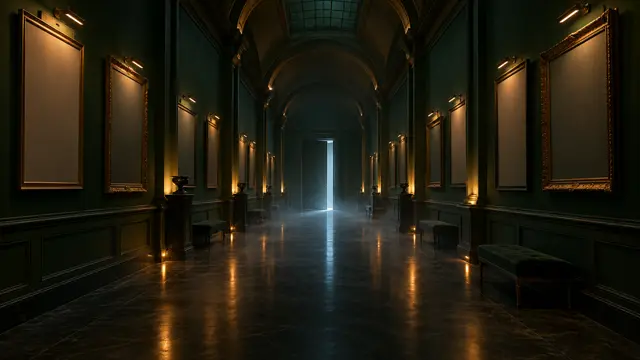
Short answer: the Academy Museum of Motion Pictures in Los Angeles has opened "The Horror Show": nearly 350 props, costumes, original posters and other objects, on display through 25 July 2027. It is arranged as a long corridor with a century's worth of posters along its walls, from which you can enter (or avoid) six chambers: Gothic horror, psychological, science, slasher (films about a killer who dispatches the characters one by one), religion and ghosts. The curators' main idea is not about being frightened but about history: on their account, horror films record what people were afraid of in their own time, and so they can be read as a chronicle of collective fears. Below: what is inside, which figures the outlet gives on the genre's popularity, and what is worth remembering from it.
How the exhibition is arranged
Jessica Niebel, the museum's senior exhibitions curator, explains the idea of the corridor simply: they wanted something that brings all sorts of different horror films from different eras and countries together, and the hallway is it. A long empty corridor really is a shared feature of the genre: the viewer knows something is round the corner and walks on anyway.
Then come six chambers, each about its own kind of horror. The most unusual solution among them is the ghost chamber: it is deliberately the sparsest, because the negative space suggests the presence of spirits who are frightening precisely because they are mostly unseen. There is also a set of Japanese prints there, showing how many forms ghosts can take.
From a sidebar in the article, useful for general knowledge: the first horror film is widely considered to be the three-minute short of 1896, "Le Manoir du Diable" by Georges Méliès, in which a bat transforms into the devil.
What is on display
Briefly by chamber, as the outlet describes it.
Gothic. First editions of Bram Stoker's Dracula of 1897 and Joseph Sheridan Le Fanu's Carmilla of 1872: Niebel wanted to acknowledge that horror films have roots beyond the history of cinema. Bela Lugosi's black cape from the 1931 adaptation she calls one of the crown jewels of the museum's collections, and next to it stands the red armour worn by Gary Oldman's Dracula in Coppola's 1992 film, designed by the costume designer Eiko Ishioka.
Psychological. Visitors are met by a German edition of Freud's Studies on Hysteria of 1895. The oldest film-related object in the whole exhibition is here too: a 1920 poster for The Cabinet of Dr. Caligari. Then Jack Nicholson's axe and red jacket from The Shining, a replica corpse of Mrs Bates from Psycho, Hannibal Lecter's straitjacket and mask, the teacup from Get Out, the storybook from The Babadook, Christian Bale's pinstriped suit from American Psycho and Kathy Bates' blue dress from Misery.
Science. A first edition of Frankenstein from a print run of 500 copies, which omits the name of its author, Mary Shelley. And original props from Alien: a Facehugger and the Xenomorph itself.
Religion. A gathering of witches from different films: Valak from The Conjuring 2, Madame Blanc from Suspiria, Dani from Midsommar, Pinhead from Hellraiser, Aunt Gladys from Weapons and Annie from Sinners. Not one of them wears a hat or holds a broom. Niebel explains the idea this way: to avoid the patriarchal view of the witch as "the old hag in the dark forest eating children" and instead show women who live at the margins of society or are cast out from it because they refuse to live by all the rules.
Why the genre is on the rise
A few figures the outlet gives. They come from a single source, Smithsonian, and the method behind them is not disclosed there, so they are worth holding as the outlet's claims.
- In recent years the genre has grown in popularity: it dominated 2024's highest-grossing English-language films and yielded the highest median return on investment compared with all other genres in 2025.
- Sinners, a story of vampires and blues music set in 1930s Mississippi, garnered an all-time-high 16 Academy Award nominations last year.
- This year the independent films Obsession and Backrooms did unexpectedly well at the box office on modest budgets. Obsession has grossed more than $500 million against a budget of less than $1 million, which is also a record.
The wording about return on investment is worth leaving exactly as the outlet gave it: the highest median return among all genres in 2025. How it was calculated is not stated there, so I will not undertake to convert it into a ratio of box office to budget.
The main idea: horror as a way of reading history
The most interesting thing in the material is not the objects but the curators' running idea. They describe horror as its own kind of historian: it documents and reflects changing collective fears.
Niebel puts it directly: the biggest lesson to be learned about horror films is that they hold up a mirror to ourselves and to our times; if you want an alternative way to study history, watch horror films over time and you will find out what people were afraid of.
Examples from the article:
- The Cabinet of Dr. Caligari (1920) distils the then-recent traumas of the First World War into a plot about a sleepwalker who mindlessly obeys an authoritarian leader's orders.
- American Psycho (2000): the pinstriped suit of a Wall Street banker leading a double life embodies a critique of the corporate consumer culture of the 1980s and 1990s. An observation of my own, not in the source: the 1931 Dracula cape and the 2000 banker's suit are two different fears, one about the supernatural, the other about ordinary working life, where the monster is indistinguishable from a colleague.
- The Substance (2024): the vials of serum conjure the never-ending litany of beauty products from social media and the pressure of beauty standards on women.
Researchers were involved in the exhibition, and their readings are presented in the article as readings.
Angela Marie Smith of the University of Utah views the 1931 versions of Dracula, Frankenstein, and Dr Jekyll and Mr Hyde as responses to the eugenics movement of that era. Eugenics was the then-current notion that people with supposedly undesirable traits should be prevented from having children. A verifiable fact is given here too: by 1931, 30 American states had adopted forced sterilization laws. She also draws attention to a wave of films in the 1960s and 1970s about pregnancy and birth, coinciding with second-wave feminism; at the exhibition that is the All of Them Witches book from Rosemary's Baby, the prop baby from It's Alive and concept art for the Xenomorph egg from the first Alien. The outlet notes separately that all three films were directed by men.
Tananarive Due, an author and film historian who teaches Black horror and Afrofuturism at the University of California, Los Angeles, talks about Candyman of 1992. The film moved the action of the source story from Liverpool to Chicago's Cabrini-Green housing project and made the killer a Black man. In her words, the place had a pretty bad reputation at the time and it was not an easy place to live, but in the hands of Hollywood it became monstrous; the film reflected a fear of urban spaces and of Blackness in those spaces. The 1992 film itself is not in the exhibition, but the hook and jacket from its 2021 sequel are on display.
What to take away from this
The curators' idea is useful outside cinema too. If fiction shows what people were afraid of, then any stream of stories around you is a cast of the fears of its time. You can test the idea itself without the exhibition: take three horror films made about twenty years apart and write down what each one frightens you with, a supernatural creature, the person next to you, your own body or technology, then set that against what was happening in those years. The sign that the method worked: you can name a specific event or change the fear is tied to. If you cannot, that conclusion is honest too: not every film is about its own time, many are driven by commercial interests or by a fashionable artistic technique.
What follows is my own conclusion, not in the source. The same question is worth asking yourself at work when something is being sold to you: which fear is being used here. If, in a conversation about buying an AI tool or automation, the seller describes a threat rather than a benefit ("you will fall behind the competition", "you will be replaced", "in a year it will be too late"), that is the same device as in cinema, only without the entertainment. How common it is I have not measured and will not claim.
What to do about it if you are deciding what to automate first. Ask the supplier for four numbers and one answer, without any talk of threats.
- How many hours a month the task takes now, and how many, by the supplier's estimate, it will take afterwards. Check the first figure against your own records for last month; that is measurable. The second is so far only the seller's forecast: it can be checked only by a trial run on one area, when you work the new way for a month and count the hours the same way you did before it.
- What the rollout costs: implementation work, configuration, data migration, training staff.
- What ownership costs per month: subscription, maintenance, payment for compute.
- Who supports the solution afterwards, and what happens if that person or contractor disappears.
Then the back-of-the-envelope arithmetic, with one caveat that is where people most often go wrong. Freed-up hours are not money in themselves: if salaries stayed the same and people simply became less busy, the company's costs have not changed. They turn into money in two cases: you actually reduce costs (less overtime, not hiring the next person, dropping a contractor), or you fill the freed-up time with work whose return you can value in money. Count precisely that benefit per month and compare it with the monthly cost of the solution. If the benefit is less than the cost, a payback date will never arrive, however long you wait. If it is greater, divide the rollout cost by the difference and you get the number of months to recouping the investment.
The sign of a healthy conversation: all four points are named and verifiable. The sign that fear is being sold to you: there are no figures, but there is a deadline after which "it will be too late". And if no suitable task has turned up yet, that is a normal outcome: spend a month recording where your staff's time goes, and come back to the conversation with the hours in hand.
In summary
The Academy Museum of Motion Pictures in Los Angeles is showing "The Horror Show" through 25 July 2027: nearly 350 objects, a long corridor of posters and six chambers by type of horror, from a first edition of Dracula and Bela Lugosi's cape to the Xenomorph and the blue dress from Misery. The outlet gives figures on the genre's rise: dominance among the highest-grossing English-language films of 2024, the highest median return on investment in 2025, 16 Academy Award nominations for Sinners and more than $500 million in box office for Obsession on a budget of less than a million. And the exhibition's main idea is simple: horror films show what people were afraid of in their years, and in that sense they can be read as history.
I work on AI agents and automation. If you would like to see my projects or discuss your own task, take a look at my portfolio.
Sources
- Smithsonian Magazine, 08.10.2026 (Matthew Taub): From Slasher Films to Vampire Flicks, Horror Movies Are More Popular Than Ever. Relive the Genre's Scariest Moments at a New Exhibition. https://www.smithsonianmag.com/history/from-slasher-films-to-vampire-flicks-horror-movies-are-more-popular-than-ever-relive-the-genres-scariest-momentsif-you-dareat-a-new-exhibition-180989624/