
Daimon Robotics is building a tactile-sensing infrastructure for robots: what the company showed at IROS 2026 and what to ask a supplier like this
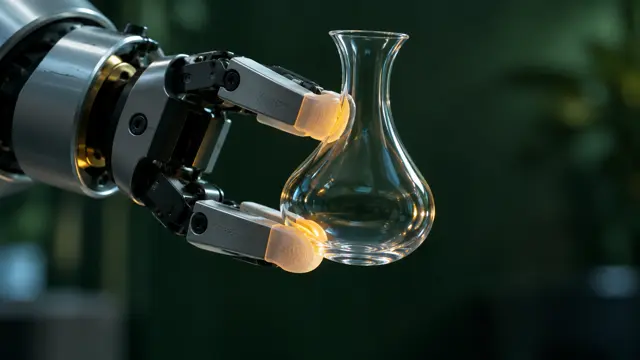
Short answer: based on a Robot Report story, instead of focusing on just one tactile sensor or one foundation model (a general-purpose AI model others later build their own solutions on), Daimon Robotics is building a pipeline that connects tactile sensors, data collection, simulation and AI models. The goal, by the company's own account, is to turn a robot's physical contact with objects into useful training data, so robots handle tasks like assembly, packaging and fragile items more reliably. Daimon's partner and VP of technology, Dr. Zhu, calls the company an infrastructure provider rather than a foundation-model developer, and is candid about the gap between simulation and the real world: in his own words, "that's not good enough, it's kind of terrible." Below is what the company claims about itself, and what questions that suggests asking any supplier making similar promises.
Why robots need touch if they already have sight
According to the source, vision has become central to modern robotics, but cameras alone aren't enough for a robot to know everything it needs about physical contact. When working with flexible objects, fitting parts, or handling fragile items, a robot needs information about force, slip and contact that vision systems can miss.
What Daimon is actually building
All the facts in this section are from the Robot Report story, by Steve Crowe, citing Dr. Zhu.
- A pipeline instead of one sensor or model. Instead of focusing only on tactile sensors or a single foundation model, the company is building a pipeline connecting tactile sensors, data collection, simulation and AI models.
- Its own role. Zhu says: "In building tactile intelligence, we're really playing the role of an infrastructure provider. We're not trying to be a foundation model developer. We're providing the infrastructure for that for people who build on top of it."
- The complexity of tactile data itself. Unlike visual data, which a camera can capture relatively easily, tactile data depends on physical contact: the result changes depending on an object's material, geometry, the forces applied, and the task itself.
- Feedback frequency. In the company's pipeline, tactile feedback runs at 30 hertz.
- Data scale. The company has discussed collecting more than 10,000 hours of data, with its longer-term Daimon-Infinity initiative targeting more than 1 million hours of tactile physical-interaction data. The source describes both numbers as what the company "discussed" and is "targeting," not an already-collected volume.
- The data-collection device. The company uses a device called Umi to capture data from human interactions with objects. By Zhu's account, the demonstrations shown were powered by foundation models trained on data from many scenarios, rather than built around demonstrations of individual robots.
An honest admission about simulation
The sim-to-real gap remains, according to the source, a significant challenge, particularly when it comes to accurately reproducing physical properties like friction and contact force. Here, simulation is a virtual copy of the task in a computer, used to train the model without constantly using a real robot. Daimon's approach starts with real-world measurements: it first checks this virtual copy against measurements on a real object and real contact (calibration), and only then uses the collected data to train in the simulated environment.
Zhu is direct about this: "Let's be frank; it's not good enough. It's kind of terrible," referring to the gap between simulated and real-world environments.
He's just as open about the limits of the models themselves: "The model's not as smart as we think it is. It has some generalization ability, but sometimes that was generalization within an already familiar domain." By his account, embodied-intelligence models are still a work in progress, and collecting data on similar tasks may help them generalize to new uses.
What was shown at IROS 2026, and who the partners are
The company demonstrated delicate manipulation at the IROS 2026 conference: applying heat-transfer designs to tote bags, stringing thread through bracelets, and a robot that collected and packaged broken glass. The source presents this as an illustration of how models trained on data from varied scenarios can be directed toward specific tasks.
The company names Lenovo Capital and Inovance Technology as key partners. By Zhu's account, Daimon has moved from the prototype stage to industrial assembly lines and warehouses, but he declined to name specific customers, citing nondisclosure agreements.
What's established here, and what remains a promise
This is my own breakdown of the material.
- Shown at IROS 2026. Delicate manipulation: applying heat-transfer designs to tote bags, stringing thread through bracelets, collecting and packaging broken glass. The source doesn't say whether these were live demonstrations or recordings.
- Described by the company separately from these demonstrations. The pipeline's architecture (sensors, data collection, simulation, models); a feedback frequency of 30 hertz for its own tasks; the named partners Lenovo Capital and Inovance Technology; the move from prototypes to industrial assembly lines and warehouses with no named customers. The source doesn't say whether this was shown at the conference itself or just described.
- An open question, not a fact either way. The source directly calls this a "commercial test": whether tactile sensing and the models built on it can consistently improve results in production settings, across different objects, materials and operating conditions. The source doesn't say this has already been proven, and doesn't say it has failed.
- A goal, not a fact. The company has discussed collecting more than 10,000 hours of data and is targeting more than 1 million hours under the Daimon-Infinity initiative; the source does not confirm these hours have already been collected, only that the company has talked about it.
What to ask a supplier making similar promises
These are my own questions for a company considering a robot or system with tactile sensing, not a conclusion drawn from the source material.
- How many hours of data are collected as of today, not how many are planned. How to check: ask for a data-collection log or a report from the last quarter with dates, not a general phrase like "we're discussing" or "we're targeting." If the supplier can't show the current figure, treat it as a goal, not a fact.
- Are there named industrial customers, or just a general mention of "assembly lines and warehouses." How to check: ask for a reference contact at a customer, or an example with concrete output figures before and after. If customers can't be named (as with Daimon, which cited an NDA), that's not a lie, but it's not proof either: factor in the risk that the result may not hold in similar conditions.
- Has the supplier agreed in writing, ahead of time, to a pilot plan on your own objects, not just the supplier's samples. How to check: the plan should name the number of distinct objects and the number of operations for each variant that matters to you (material, size, condition), rather than repeated operations on the same sample, what counts as a successfully completed operation for your task (for example, a part is assembled and holds, packaging is intact after normal shipping), and separate (not combined) acceptable rates of defects and damage. A report on results after the fact, without such a plan agreed beforehand, doesn't count as proof: there's nothing to compare the numbers against.
- Does that plan also test speed and the full cost per operation, besides quality, at a volume close to your normal workload, and what happens if the plan isn't met. How to check: ask that the same written plan include speed and per-operation cost thresholds at your normal workload, not just a small trial batch, and a written condition for what happens if the plan isn't met: the supplier fixes the system at no extra cost and retests, and scaling up only happens once all thresholds are met. A verbal promise to "help out if needed," without this in the contract, doesn't count.
- Does the simulation's result match the result on a real object, specifically for your operation. How to check: before testing, together with your own engineer or process specialist, agree in writing with the supplier on which measurable metrics for your operation (for example, grip force in newtons) and what maximum discrepancy for each you'll use to compare the simulated result with the result on a real object. Then ask the supplier to show both numbers side by side for each agreed metric. If the supplier refuses to agree on metrics and limits beforehand, can't show both numbers, or even one discrepancy exceeds the agreed limit, treat the simulation's accuracy here as unverified or insufficient.
- Is the claimed feedback frequency confirmed for your specific task. How to check: ask for a feedback-frequency measurement on your material and your operation, not a general demo or a figure for someone else's task (here, for example, 30 hertz is a figure for Daimon's own pipeline on its own tasks).
Bottom line
Daimon Robotics is building an infrastructure that connects tactile sensors, data collection, simulation and AI models, instead of focusing on one sensor or one model, and directly calls itself a supplier for other robot developers. The company showed delicate manipulation at IROS 2026 and named two partners. It did not disclose customers or figures on production improvement. And its VP of technology himself describes the gap between simulation and reality as "not good enough, it's kind of terrible." For a company evaluating a supplier with similar promises, it's worth asking the same things: how much data is collected as of today, whether there are named customers, and whether a written pilot plan on its own objects, with thresholds for defects, damage, speed and cost, has been agreed in advance, before paying to scale up.
I work on AI agents and automation. If you'd like to see my projects or discuss your own task, take a look at my portfolio.
Sources
- The Robot Report, Steve Crowe: Daimon Robotics building the infrastructure layer for tactile intelligence. https://www.therobotreport.com/daimon-robotics-building-the-infrastructure-layer-for-tactile-intelligence/