
Eka Robotics valued at $1.45 billion for a robot that doesn't crush a raspberry: what's claimed and what questions it raises
Short answer: startup Eka Robotics closed a Series A round of $150 million at a $1.45 billion post-money valuation, led by a16z and F-Prime. Based on TechCrunch, the company built a manipulation robot that, instead of relying mainly on vision, judges the force of contact with an object, and independent experts call the demo they saw unusually impressive. At the same time, the company has not yet proven this works on an actual production line: its pilots are non-public, and in the article author's assessment, the leap from lab to line is nearly as big as the gap between simulation and reality. Below is what's claimed, what independent experts say, and what questions the experts themselves call open.
Where this comes from
Source: the TechCrunch article "Eka is worth $1.45 billion thanks to a physical AI model that has experts raving," published 20 October 2026.
Who they are and how much they raised
Eka Robotics was founded by MIT professor Pulkit Agrawal and former Google DeepMind researcher Tuomas Haarnoja, who met in graduate school at Berkeley. The company closed a Series A round of $150 million, after which investors value the whole company at $1.45 billion (this is a valuation of the business that includes the money just invested, "post-money," not an amount the company has received or already earned); the round was led by venture funds a16z and F-Prime. Raghu Raghuram, the a16z general partner who co-led the round, told TechCrunch: "They are already exceeding human performance in certain tasks, and so we think over the next few months there will be superhuman performance in many dexterous manipulation tasks." These are the words of an investor who put money into the company, in other words an interested party.
What the robot showed, according to independent experts
Kris Hauser, a professor at the University of Illinois Urbana-Champaign with no ties to the company, said Eka's demo had a "wow factor" compared with other robot demos he's seen recently. By his account, the Eka robot "was able to adapt to a large number of different objects without retraining," and had an aspect of "humanness, creepy humanness": if a grasp failed on the first try, the robot tried again and again.
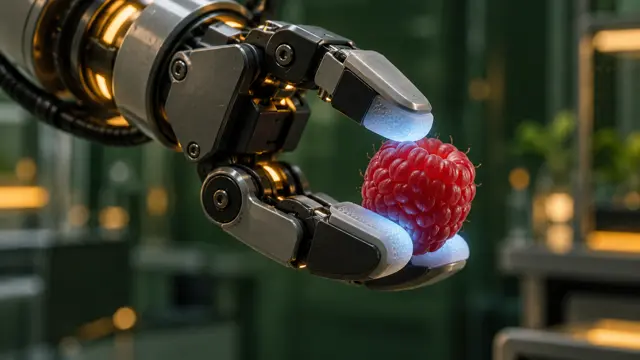
Another roboticist, who asked to remain anonymous because of their work at a frontier lab, told TechCrunch that seeing Eka's robot in action was an emotional experience, comparable to when robots first achieved reliable legged locomotion five to ten years ago. This person handed the robot a raspberry, their lab's favorite test object: "The experience of a big, heavy robot rushing towards my arm and then slowing down just in time and very gently touching me is a feeling that I am, as we speak, carrying this feeling in my body."
According to TechCrunch, the robot picks up about 1,500 objects weighing up to 1 kg per hour (about 600 for a human). The source directly attributes the greater-than-95% reliability figure to the company's own claim ("Eka says"); where the 1,500 and 600 figures come from is not specified in the article. Neither figure is independently verified in the article. The robot's arm is strong enough to hurt itself moving that fast, and, in the anonymous source's own speculation, this means: "they have a lot of trust in their algorithm not breaking the robot. I wonder how many robots they broke along the way?" This is the source's own guess, not a fact confirmed by the company.
What's different about Eka's approach
Instead of a vision-language-action model, which learns the relationship between language, images and action, Eka uses a vision-force-action scheme. The TechCrunch article itself describes it as the relationship between language, force data and action, even though the scheme's name includes "vision" rather than "language": vision still appears to be involved (further down, Agrawal says it roughly shows an object's position), but the article doesn't explicitly explain how the scheme's name relates to that description. Co-founder Agrawal explained it this way: "Vision is not the primary way in which you close this last millimeter problem. Vision tells you roughly where the object is, what the pose is, but the actual grabbing, the actual searching is happening through forces."
To achieve this, Eka designed its own robotic hand, more flexible than standard grippers and with more force sensors: it reacts to contact, which is why it doesn't crush the raspberry. The founders don't disclose exact details for competitive reasons, but at its core is a physics simulator that models the forces involved in grasping an object, and reinforcement learning run inside that simulator at large scale. By the company's account, this lets them generate thousands of hours of robot experience in minutes.
Hauser separately noted that this is the most interesting part: "Rather than being limited to the data that you're collecting from, say, human demonstrations, Eka is pushing through reinforcement learning this approach where the robot can surpass any kind of demonstrations that are given to it." In his words, the ability to not be limited by what it was shown during training is what's most impressive here.
What this could be useful for, and what's still unproven
Right now, according to the article's author, the most generalizable physical AI models, the ones capable of many different tasks, aren't particularly good at performing them, while models built to excel at a single task may not support a company's business case. Example: ChatGPT's latest model, Astra, can operate a robot in an unfamiliar setting, but slowly and at high cost. Eka's idea is that a model like theirs handles the physical movement itself, while a more general model like Astra decides what needs to be done at all. Co-founder Haarnoja put it this way: "Most of the field has been focusing on the planning, so they approach from the top: high-level intelligence, pushing that down towards the physical. Whereas we think about it from the bottom up."
But the company still has to prove itself in practice. Eka is working in non-public pilots with a number of industrial customers on pick-and-place and wire-handling tasks; TechCrunch doesn't name the customers. Hauser himself names the biggest challenge ahead as working with integrators on real assembly lines, where the robot needs to run for a year without breaking, and separately flags an open question: how generalizable the technique is to other tasks, since what he's seen so far is pick-and-place, while many industry tasks worth automating go beyond that.
Agrawal says he himself is focused on deployability: Eka's gripper costs less than $1,000 and is rated for 5 million operating cycles, while the company's ultimate goal, 20 million cycles, is the bar standard industrial arms already meet.
What's established here, and what remains a claim from the company or an investor
This is my own breakdown of the article.
- Confirmed by TechCrunch's independent sources. The impression that the demo was unusually strong compared with other robots (Hauser), the ability to adapt to different objects without retraining (Hauser), the anonymous source's emotional reaction to the raspberry test.
- Claimed by the company itself, with no independent verification in the article. Reliability above 95%, a gripper price under $1,000, 5 million operating cycles, thousands of hours of simulated experience generated in minutes. The source gives the figures of 1,500 objects per hour and 600 for a human without saying where they come from.
- Open questions the experts themselves call unresolved. Whether the robot will run for a year on a real line without breaking (the source doesn't specify whether this work needs to be continuous), and how well the approach generalizes to tasks harder than pick-and-place.
What a company considering a manipulation robot should take from this
These are my own conclusions, not advice from the source material.
- A loud demo and a high investor valuation don't substitute for results on your own task. Even the independent experts quoted in the article are praising the demonstration itself, not proven production performance: before planning a deployment, ask any supplier, Eka or otherwise, for results from pilots similar to your own task, not for impressions of a demo.
- Reliability figures (95% and similar) can't be verified without details on the methodology. How to check: ask on how many objects, and which ones, that figure was measured, and whether those objects match what you'd actually be working with. If the supplier can't answer, treat the figure as marketing, not as verified for your task.
- For tasks harder than pick-and-place, ask for separate evidence. The expert quoted in the article says plainly that what he's seen is pick-and-place, while many industry tasks worth automating are harder than that. If your task isn't just picking up and placing objects, don't treat ability at one kind of task as automatic proof of ability at another.
Bottom line
Eka Robotics raised $150 million at a $1.45 billion valuation for a manipulation robot that, instead of relying mainly on vision, judges the force of contact with an object, and earned high praise from independent experts for its demo. But reliability above 95% and other figures are claimed by the company itself with no independent verification in the article, its industrial pilots are non-public, and the same experts who praised the demo explicitly name reliability on a real line over a year, and the approach's ability to work beyond pick-and-place tasks, as open questions.
See also another story from the Robots section.
I work on AI agents and automation. If you'd like to see my projects or discuss your own task, take a look at my portfolio.
Sources
- TechCrunch, 20 Oct 2026: Eka is worth $1.45 billion thanks to a physical AI model that has experts raving. https://techcrunch.com/2026/10/20/eka-is-worth-1-45-billion-thanks-to-a-physical-ai-model-that-has-experts-raving/